Inseparable from the Rouen 1899 Football Club and its Red Devils, the Robert-Diochon stadium has seen the club’s finest hours and the great atmospheres that have made its reputation in France and earned it the nickname “Red Cauldron”!
Founded in July 1899, the FCR played its first matches on the meadows of Sotteville before moving to the Bruyères racecourse (located just opposite the Diochon stadium) the following season. The club played for eight consecutive years on the racecourse before moving to the Petit-Trianon stadium (located on rue d’Elbeuf in Rouen) in September 1908, which had no stands. In 1911, the club moved a few meters further to the Grand-Trianon stadium.
The Grand-Trianon stadium was notably the scene of the final of the USFSA French championship in 1913 between the FCR and the Stade Helvétique (match played in front of 10,000 spectators!)
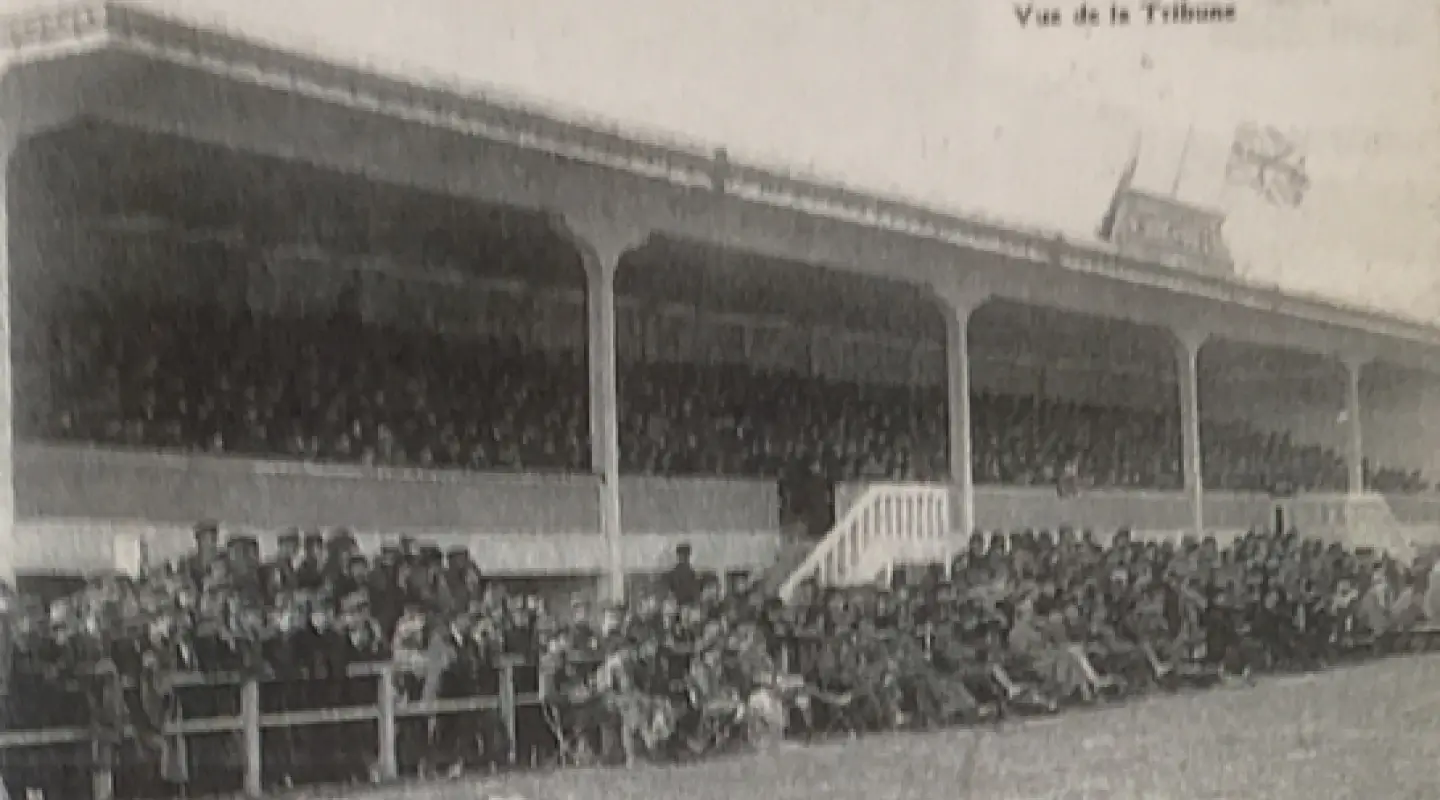
Faced with the growing popularity of the FCR at the beginning of the 20th century, the FCR obtained from the Rouen municipality the concession of the Bruyères land on which a stand with changing rooms for the players, visitors and students of the Physical Culture School would be built. The Bruyères stadium (now called the Robert-Diochon stadium) was inaugurated on June 7, 1914.
In 1930, the stadium was transferred to its current location and the Stade des Bruyères experienced the first hours of French professional football with the FCR joining Division 2 in 1933, then Division 1 in 1936.
The first night matches took place in the early 1950s with the installation of electricity pylons. Then, the Stade des Bruyères became the Stade Robert-Diochon in September 1953 after the death of the illustrious president of the FCR who led the club for 46 years (from 1906 to 1907 and from 1908 to 1953). A longevity that is still a record in French football today!
While the early 1960s marked the FCR’s return to the elite in a sustainable way, with European epics against prestigious clubs, the stadium quickly proved unsuitable for hosting the public. Until then owner of the stadium, the Rouen Football Club gave its enclosure to the city of Rouen in exchange for a complete renovation which would notably see the construction of the grandstand. Built from 1963, the new grandstand was inaugurated on June 10, 1964 with a friendly match against the famous Spanish club Real Madrid, in front of 15,000 spectators!
Finally, in 1968, the Shell stand (now the Lenoble stand) was built in turn and became the lungs of the Robert-Diochon stadium, welcoming the most fervent FCR supporters to every match!
It was in this new configuration and despite the Rouen club’s fall to Division 2 that the Robert-Diochon stadium would experience its attendance record, on April 8, 1977 during a match of the round of 16 of the Coupe de France. The Red Devils then faced the illustrious AS Saint-Etienne of Larqué, Rocheteau and Révelli (triple French Champion and finalist of the European Champion Clubs’ Cup). In a Diochon stadium in fusion, the Red Devils held their own against the greens and snatched a draw (1-1)!
The stadium accompanied the Red Devils through the decades and the club inaugurated its training center behind the Tribune d’Honneur in January 1983. However, its growing dilapidation gave rise to the idea of a new stadium for the 1998 World Cup in the early 90s, but the fall of the FCR in amateur football put this project on the back burner. Thus, in the year 2000, with three stands removed, the stadium could only accommodate 2,000 spectators
In order to meet new safety standards, a renovation phase began in the early 2000s with the redevelopment of access to the stadium and the installation of tubular structures for the Zénith and Bruyères stands.
Then, the sporting rise of the Rouen 1899 Football Club to Ligue 2 for the 2003-2004 season allowed the rehabilitation of the Tribune d’Honneur to begin, with the support of the city of Rouen, which was equipped with a new roof and boxes to accommodate partners in better conditions. The Tribune d’Honneur opened for the Normandy derby against Le Havre and increased the stadium’s capacity to just over 12,000 spectators!
The city of Rouen handed over the Robert-Diochon stadium in 2015 to the Rouen Normandy Metropolis, which began work in 2017 with the help of the Normandy Region to meet the new security standards for Ligue 2, including the installation of video surveillance, the relocation of the playing area and the destruction of the legendary Diochon tunnel, which was replaced by a foldable structure.
With a capacity of 8,372 seats (including 6,565 covered seats), the Diochon stadium is continuing its facelift with a second phase of work which will begin in 2021 and for delivery at the end of 2022.
Work that will include the preliminary demolition of the refreshment bar, the luggage storage area and the ticket office in order to provide a more accessible forecourt for the public. In addition, the Lenoble stand will house the club’s new administrative premises (the premises located behind the Daniel-Horlaville stand will be destroyed), the shop, the luggage storage area and the ticket office.
4 Aug, 1977
Spectators – 23,532
4 Aug, 1961
Spectators – 22,805
6 Mar, 1951
Spectators – 22,627
21 Sep, 1958
Spectators – 22,360
4 Aug, 1969
Spectators – 21,942
48 avenue des Canadiens, 76140 Le Petit-Quevilly


